F-16.net

Printed from: F-16.net - The Ultimate F-16 Reference [http://www.f-16.net]
Document title: F-16 Armament - M61 A1 Vulcan - F-16.net - The Ultimate F-16 Reference
Original URL: http://www.f-16.net/f-16_armament_article5.html
Printed on: 15 October 2008

M61 A1 Vulcan

20mm gatling gun system

Introduction

The General Electric M61A1 Vulcan is a 6-barrel 20mm cannon of the gatling-type. It fires standard M50 ammunition at 6,000 rounds per minute (rate selectable in certain installations).


History

In 1947 the brand new USAF made a request for a new aircraft gun. The lesson of WWII was that the German, Italian and Japanese fighters could reach out and touch the Americans with their cannon main armament, while the latter had to get up close and personal with the .50 cal main armament of the P-51 and P-47. The 20mm Hispano carried by the P-38 was a relatively low velocity weapon. The idea of hooking up unlimited ammo to a late 19th century "Gatling" type weapon, and powering it electrically was attempted by the US Navy for use on their Torpedo/gun boats. Results were high rate of fire and a high rate of barrel wear out. With propellants of the time and period metallurgy it was a good idea but one that was not ready until new technology came along.

In 1950, the US General Electric Company began designing a cannon for USAF fighters under the Vulcan Project, based on the multi-barrel concept pioneered by Richard J. Gatling in the 19th century. The Vulcan was first fired in pre-production form in 1953, and made its first flight in the Lockheed F-104. Initial problems with the gas bleed resulted in a temporary suspension of firing tests, until a better venting system for the F-104 gun compartment was designed.

Today, after a period of neglect (when guns were thought to be rendered obsolete by missiles), the M61 in one form or another, is an integral part of the armament of modern fighters such as the F-15, F-18 and of course the F-16.

Recently, GE's armament division was acquired by Martin Marietta, so the M-61 is now officially known as the Lockheed-Martin M61A1.

Construction


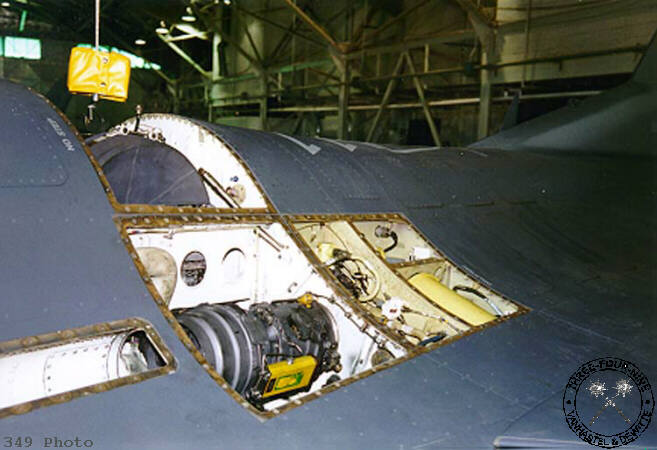
Gun Maintenance at Hill AFB: the barrel assembly has already been removed, while the ammo drum is currently being lifted out. (F-16.net photo)
The multiple-barrels cannon offers both advantages in firing rate and in barrel life. As the 6 barrels revolve, they proceed through the different stages of the gun firing cycle. Each barrel is fired as it passes through the top position, after which the spent case is extracted and ejected, and a new round is fed and chambered - all at different positions on the circle described by the revolving barrel. This means that the firing rate is multiplied by the number of barrels, as six barrels are being loaded in parallel. Furthermore, since each barrel is only fired at 1/6th of the total firing rate, barrel wear and tear is not increased. Major drawback is that ammunition is consumed at a vast rate, requiring large ammo magazines.

The gun is fed through long linked belts of ammo, and although the gun appeared from early on in the development to be extremely reliable, the unprecedented rate of fire caused severe problems with these belts. The links connection the rounds often bent, broke or stretched, causing the gun to jam. Furthermore, provisions had to be made to dispose of the links. As a result, development of a new linkless feed system quickly started. Inside the drum, the rounds (tips to the middle) are placed in a giant Archimedean screw which moves them into the conveyor belt feeding the gun. In the F-16 and some other installations (M61A1 installations are tailor-made to each aircraft type), the empty case is transported back to the drum via a second conveyor belt. Both conveyor belts are housed in strong flexible ducts, and are powered by the gun, as well as the screw inside the drum which is driven via a high-power flexible coupling.
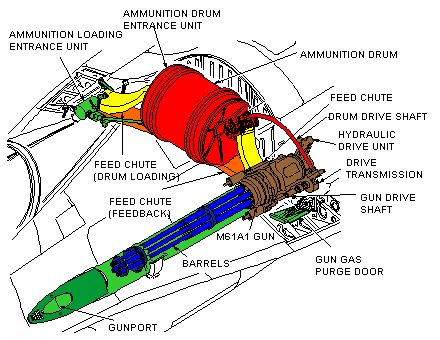
Most members of the M61A1 family are driven by the aircraft's hydraulic system, or (exceptionally) by the electrical power system. 35hp is needed to drive the gun at full firing rate, and barrels rotate anticlockwise when viewed in the direction of firing. The stationary breech housing has a deep elliptical slot in its inner wall in which run 6 cam followers, on the breech of each barrel. The followers are driven linearly in and out of the associated breech, successively chambering, firing and extracting the rounds. The breech rotor, to which are attached the 6 barrels, revolves inside the breech housing.

At the muzzle end, the 6 barrels are fitted in a clamp. This clamp can be replaced by other models, thereby offering a means to vary the barrel angles and create slightly different dispersion patterns. The inside of each barrel is provided with a twisted groove to give the rounds a spinning motion.

F-16 Installation

The M61 installation in the F-16 encountered some initial problems, most notably in September 1979 when firing the gun was temporarily forbidden. Two incidents had occurred in which gun firing resulted in uncommanded yawing movements. The cause of this problem was an accelerometer in the flight-control system being affected by the vibrations caused by the operation of the gun. The accelerometer fed false data into the flight computers, which initiated the yaw movements. Simple insulating the accelerometer from vibration solved the problem. All 106 operational F-16s delivered to date were retrofitted during 1980.


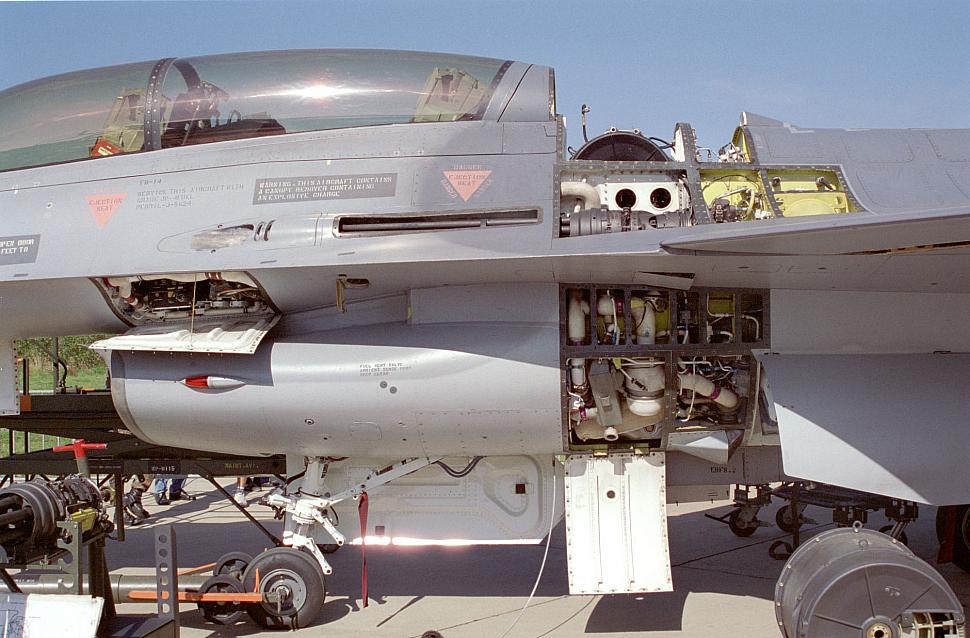
M61 A1 Vulcan installation in a BAF F-16B, with all access panels open. (F-16.net photo)
The ammo drum is located just aft of the cockpit, with the ammo loading access door in the bottom half of the starboard wing, next to the air intake. The gun itself is located in the upper port side of the fuselage, with the gun port on the port side of the cockpit. The ammo drum has a 511-round capacity.
The gun controller is the electronics unit which actually controls the firing of the gun. A voltage pulse is sent out from the gun controller to fire each round in a firing burst. At the end of a burst when the trigger is released, the gun clears itself. In the clearing operation, 5 to 9 unfired rounds are cycled through the gun without firing pulses, and are fed back to the ammo drum. These rounds are carried for the duration of the flight as spent rounds and cannot be used. The SMS (Stores Management System) has a rounds remaining counting function which counts each firing pulse from the gun controller and subtracts these from the loaded number of rounds. In the clearing operation, however, there are no pulses or any way of determining the actual number of rounds cleared, therefore the SMS assumes 7. Due to this fact there can be a discrepancy between the rounds remaining on the SCP and the actual number of rounds left to be fired. This discrepancy can become larger with increasing number of clearings.

Operational Use

The gun takes about 0.3 seconds to wind up to the full rate of fire, and half a second to wind down again. Some critics (notably defense analyst Pierre Sprey in a paper called First Rounds Count) argue that the aim is at it truest when the pilot pulls the trigger, and that it starts wandering off almost immediately.
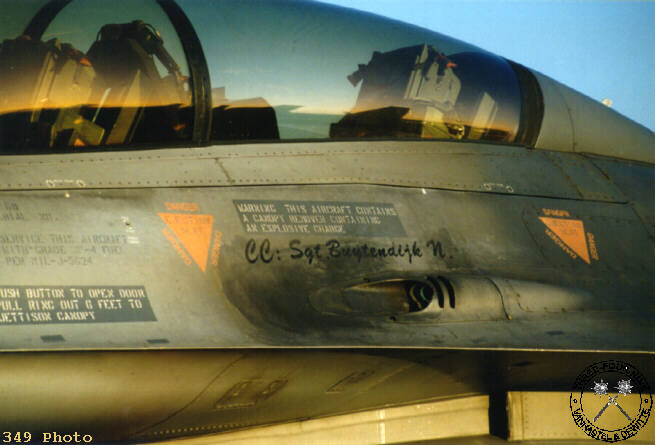

A close-up of the gunport of a Dutch F-16B after a live-firing exercise. Hot gasses from the muzzle have left carbon traces, which -if not removed- corode the paint. (F-16.net photo)

Close up of the M61 gunport on a Norwegian F-16A. The copper color is copper-grease, applied to the gunport to protect it from the hot gasses during firing. Burns from the gasses are difficult to clean after a firing period. (F-16.net photo)


Therefore, the 0.3 seconds delay would cause the gun to fire just after the piper was best aligned with the target. A revolver cannon such as the Mauser BK27 (fitted in the Tornado) does not have this problem, as it reaches its maximum rate of fire instantly. A simple calculation however shows that the M61 fires 70 rounds in the first second (6,000 rounds/minute = 100/second. 30% of the first second is waisted on winding up, so that leaves 70 rounds fired in the first second). The BK27 fires at 1,700 rpm, or 28 rounds per second.
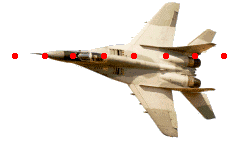
In order to fire the same amount of rounds in the first second, you'd still need 3 BK27's in stead of one Vulcan - quite a challenge to fit them in the limited space available in an F-16!

The rate of fire of 6,000 rpm or 100 rps means that shells are spaced by 0.01 sec. A MiG-29, with a length of 56ft 5in (17.20m) and 90? angle-off (i.e. with a direction of flight perpendicular to the direction of flight of the F-16), flying at 543kts (1,000 km/h) or 278m/sec travels 2.78m in 0.01 sec. Therefore, the Fulcrum will be hit at least 5-6 times if the aim is true (17.2/2.78=6.187).

Specifications

Sound

Due to the extremely high rate of fire of the Vulcan, it is impossible to distinguish between individual 'shots'. Quite different from the typical movie sound-effects, the M61 sounds more like a heavy concrete drill. The 5 sec. sound fragment is actually from a VADS (Vulcan Air Defense System), used by a.o. the Belgian Air Force for point defense of its airfields. Unfortunately, only the .AU file format is currently available - most browser however support this format.

Ammunition

The components that make up a complete round are a brass cartridge case, an electric primer,propellant powder, and the projectile. The projectile is fired when an electrical pulse is applied to the primer. The resulting flame passes through a gas vent leading to the propellant chamber and ignites the propellant. As the propellant burns, it forms a gas which forces the projectile through the gun barrel. The only significant difference between the five types of ammunition is in the projectile. Located at the rear of all projectiles is a band of soft metal that seats in the grooves of the gun barrel. The grooves in the barrel are twisted so that the projectile receives a rotating motion as it travels through and leaves the gun barrel. This rotation is induced to provide stability in flight. The soft band also serves to prevent the propelling gas from escaping past the projectile.

Dummy Ammunition

The dummy ammunition color code may be either bronze or shades of gray or tan. The case will be steel or plastic. Dummy ammunition is used to check out the gun system.

M55A1/A2 Target Practice Round (M220 TP Tracer Round)

The M55A1 and M55A2 target practice (TP) round is ball ammunition, with a body made of steel. The projectile is hollow and does not contain a filler.

M53 Armor-Piercing Incendiary Round

The body of the M53 armor-piercing incendiary (API) projectile is composed of solid steel. The nose of the projectile is made of aluminum alloy, charged with an incendiary composition, and sealed with a closure disk. The projectile does not require a fuze because it ignites upon impact.

M56 High Explosive Incendiary Round (XM242 HEI Tracer)

The M56 high-explosive incendiary (HEI) round contains an HEI projectile. The round is used against aircraft and light targets. The projectile explodes with an incendiary effect after penetrating the surface of the target. HEI projectiles require a fuze which has a delay arming distance of 20 to 35 feet from the muzzle of the gun. Centrifugal force, created by the projectile spin, allows the detonator to align with the firing pin and the booster, thereby arming the round. Upon impact, the projectile presses into its target, crushing the nose of the fuze and forcing the firing pin against the detonator. The booster, initiated by the detonator, causes the projectile to explode.

PGU-28

Starting with Block 50 (as far as the F-16 is concerned anyway), provisions have been made to fire the new 'hotter, faster, farther' PGU-28 round. It reputedly travels three times as far as the standard M53 round, effectively closing the gap between the Sidewinder minimum engagement range and the gun's maximum engagement range.

Ammunition Specifications
Weight (lbs)Length (in)Diameter (in)
All-upProjectileOverallCaseProjectileProjectile
M55A10.560.226.624.022.980.79
M55A20.560.226.624.022.980.79
M220 Tracer0.560.226.624.022.980.79
M53 API0.570.226.624.022.980.79
M56 HEI0.560.226.624.023.030.79
XM242 HEI Tracer0.560.226.624.023.030.79

Specifications

Length: 1,875mm (73.8in)

Weight: 120kg (265lbs)

Muzzle Velocity: 1,036m/s (3,400ft/s)

Rate of Fire: Max 6,600 rps (can be set to 4,000 or 6,000)


Errors and Omissions

Aug 07, 2003 - 05:01 AM

The description on the picture phl-195.jpg is wrong. The Coppery-colored markings is a copper-based grease-like substance put around the gunport-opening and surrounding area before a flight where the cannon will be fired. This is done to make it easier for the ground crew to wash off the gunpowder-rezidue when the aircraft is due to be washed. I do not know if this is done in any other airforces that the RNoAF.

As for validity: I served as a CrewChief-Assistant during my mandatory Military-service, and one of my tasks was to apply the "copper-goo" to the aircraft before a firing was scheduled, and to wash it off when the aircraft i was assigned to that day was washed.


Feb 15, 2004 - 05:46 PM

The gun controller is the electronics unit which actually controls the firing of the gun. A voltage pulse is sent out from the gun controller to fire each round in a firing burst. At the end of a burst when the trigger is released, the gun clears itself. In the clearing operation, 5 to 9 unfired rounds are cycled through the gun without firing pulses, and are fed back to the ammo drum. These rounds are carried for the duration of the flight as spent rounds and cannot be used. The SMS (Stores Management System) has a rounds remaining counting function which counts each firing pulse from the gun controller and subtracts these from the loaded number of rounds. In the clearing operation, however, there are no pulses or any way of determining the actual number of rounds cleared, therefore the SMS assumes 7. Due to this fact there can be a discrepancy between the rounds remaining on the SCP and the actual number of rounds left to be fired. This discrepancy can become larger with increasing number of clearings

The above info is not completely correct. The firing voltage is not "pulsed" it is constant when the trigger is pulled. A contact on each breech bolt comes in contact with a small wire contact and completes the circuit to the round. Also there is no discrepancy in the rounds remaining shown on the MFD it is a simple 10 round count. It is displayed at 51 for 511rnds and 25 for 250. This indicates how many rounds are left in the system that can be fired with a 10rnd error. Even if the gun does not turn each pull of the trigger will indicate 10rounds fired. For example 51 goes down to 50 during ground functional checks. Futhermore the color coded picture has some errors. The muzzle end of the gun extends all the way into the muzzle port and the drive system to the gun is in a different bay. The power goes to the gun solely through the drive shaft and the flex drive.

F16 462/2W1 18 years. 32spoke@msn.com


Feb 15, 2004 - 05:47 PM

The gun is not selectable in fire rate. It is fixed at 6000 rndspm


Mar 04, 2004 - 09:18 PM

What is the ground on the firing lead for?


Mar 27, 2004 - 04:08 AM

The ground on the firing lead keeps you from getting your snot knocked off while doing func checks. It really just grounds back to shield on the gun firing lead so you have a more positive contact than you could get from just he gun in the mounts. A vibrating gun in a vibrating mount, 2 of which have a rubber type of stuff surrounding them just don't make the best ground. Really if the lead is broken and you don' t properly check it you get aprox 250vdc juiced through your airman on the ladder. Been there and got the tshirt.

EriktheF16462


Apr 07, 2004 - 02:17 PM

(1) "The lesson of WWII was that the German, Italian and Japanese fighters could reach out and touch the Americans with their cannon main armament, while the latter had to get up close and personal with the .50 cal main armament of the P-51 and P-47."

In feite was het effectieve bereik van de .50 even groot of nog groter dan dat van de meeste 20mm kanonnen, dankzij de uitstekende karakteristieken

van de munitie, en aanzienlijk groter dan dat van praktische 30mm wapens. Wat de .50 tekort kwam was vernietigingskracht, niet bereik. (Hetzelfde geldt

vandaag eigenlijk voor de 20mm.)

(2) "The 20mm Hispano carried by the P-38 was a relatively low velocity

weapon."

Zeer zeker niet. De mondingssnelheid van de Hispano M2 was 880 m/sec, zelfs iets meer dan die van de .50, en een van de hoogste waarden voor de vliegtuigbewapening uit die tijd. Het is waar dat enkele van de door de Duitsers en Japanners gebruikte 20mm wapens een lage mondingssnelheid hadden, maar dit wordt vaak (en volkomen ten onrechte) geextrapoleerd naar alle 20mm wapens.

Emmanuel Gustin


Apr 07, 2004 - 05:42 PM

Hello. I was looking at you page for the F-16 concerning the Vulcan cannon and have a point that I'd like to mention. I am a US Air Force weapons technician with 6 years experience on the F-16 and 7 years on the F-15.

In the first paragraph of the Operation portion of your article you mention criticism of the system for not delivering acurate aim except at the beginning of fire (my words) and that aim begins to wander after that. The Vulcan system as used in the F-15 and F-16 is not intended to be rigidly stable and not deliver a line of fire as depicted in the illustration of the Mig 29. The Vulcan system delivers a dispersed pattern similar to a shot gun, ensuring a higher probability of hits in a single burst as opposed to a line of fire weapon like single barrel systems.

I have witnessed many night firings using tracer ammunition and seen what I would call a "cloud" of tracer being let loose on the target area.

By watching gun camera recordings, you can see that there are too many variables (pilot control inputs, G forces, opposing pilot evasion, and weather conditions) to allow any pilot to maintain the pipper on his target effectively. This was the reason the Vulcan system is intentionally unstable and allow maximum effective use of ammo.

I would imagine that any fighter using the same gun system has a similar pattern of fire.

I rather doubt that the blackish discoloration of the aircraft in the photo of the RNIAF aircraft is any protectant. This is normal at the end of the firing day and is cleaned with suitable aircraft soap and water.

Lastly, the newer ammunition is capable of being used in any existing gun system without modification, since the Block 50 aircraft use this sytem also.

I hope I'm not being too picky about little facts, but I like the public to have a more realistic idea about aircraft weaponry. Thank you.

Marty


Jun 03, 2004 - 12:19 AM

The M61 A1 Vulcan is behind the line when it is compared to the Mauser BK27 27mm revolver single barrel canon or the rusian GSH-301 30mm single barrel canon.

The GSH-301 veights only 47 kg and it has a rate of fire 1500-1800 spm.

The 30mm projectils weights aproximately 400g and the muzle velocity is 860 m/s.

With advanced CCIP 30 shots per second is enogh in todays very rare canon dogfihts and for ground targets a 30mm round is much beter suited.

The M61 A1 Vulcan is a old design and low performance canon from mid 60s.


Jun 03, 2004 - 12:24 AM

Air to air shootdowns with guns are getting scarcer!!!!!!!!!!!!

Israel: Six Day War, 100% (of 60), lack of dependable AAMs.

War of Attrition, 70% (of 113); missiles Shafrir 30%.

1970-73, 70% (of 34); missiles 30%.

Yom Kippur War, 30% (of 277); missiles 70%.

1973-79, 17% (of 6); missiles 83%.

1979-82, 9% (of 229; missiles 91%.

Lebanon 1982, 7% (of 85), missiles 93%.

1982-90, 0%, missiles 100% (of 3).


Jun 03, 2004 - 12:30 AM

The M61 A1 Vulcan 100spm sounds good against the GSH-301 30spm but against when comparing a 0.5 sec burst of fired rounds the numbers are much closer.


Jun 03, 2004 - 12:47 AM

To the fulcrum hit picture.

The hits are computed with 100 spm but the M61 fires about 70 rounds in the first second as stated in previous axplanations!!!!!!!!!!!!!!!!!!!!!!!!!

And again to the GSH-301. One or two hits from a 30 mm HE-I projectile could be fairly enough.


Jun 03, 2004 - 01:11 AM

The GSH-2-30 is a 30 mm double-barreled aircraft gun used on su-25. This weapon uses the Gast principle, named after its inventor Carl Gast, who developed it in Germany during WWI. In these guns, the firing of one barrel drives the action of the other half of the gun. The gun veights only 105 kg which is lower than the vulcan and has a rate of fire 3000-3400 spm. It uses the same amunition as the GSH-301.


Jan 10, 2005 - 05:05 AM

The following are quotes from a comment above and my replies.

"The M61 A1 Vulcan is behind the line when it is compared to the Mauser BK27 27mm revolver single barrel canon or the rusian GSH-301 30mm single barrel canon.:

No, they aren't.

"The GSH-301 veights only 47 kg and it has a rate of fire 1500-1800 spm."

A single shot rifle might only weigh 4lbs, whereas a fully automatic rifle will weigh 8lbs... But which one does a soldier use?

"The 30mm projectils weights aproximately 400g and the muzle velocity is 860 m/s."

Big deal, weight, speed and size of a bullet doesn't matter much if the target just flies right between the bullets, thanks to your 30 round per second gun.

"With advanced CCIP 30 shots per second is enogh in todays very rare canon dogfihts"

No, it isn't, period.

"and for ground targets a 30mm round is much beter suited."

To a ground pounder, both 20mm and 30mm will reallly ruin your day. And which do you think gives a ground troop more ngithmares, the idea of having 30 30mm bullets fly at him, or 100 20mms?

"The M61 A1 Vulcan is a old design and low performance canon from mid 60s."

Compared to.... what? Got news for you bud, other than what's made by the US, UK and Isreal, everything else is 50 years behind, to put it in english, all you other nations are just now starting to catch up. Also keep in mind that the basic AIM-9 sidewinder is a design from the 40's, and its still one of the better AAMs in the world, and its modern decedents are still THE best in the world.


Mar 22, 2005 - 10:05 PM

As a former Vulcan gunner I will always be partial to gun systems in spite of obvious limitations. However, gun systems still play a part in air defense and employment against ground targets. Air defense weapons are only as good as the fire control/guidence systems designed to deliver rounds (or missiles) to the target. The vulcan is still a good gun when employed in air to ground or ground to ground mode. A fast hundred rounds of HEI going towards the bad guys can make the difference in defending against ground attack or preventing an aircraft from delivering ordnance where intended. Trade off: bigger gun, carry less ammo.


Apr 04, 2005 - 07:27 PM

You need perhaps 10 rounds or more of 20mm ammunition to ensure a kill, but only one or two of the 30mm. Also the 30mm has a grater range and accuracy. I prefer the Gsh301 cannon.


Apr 08, 2005 - 10:56 PM

"And which do you think gives a ground troop more ngithmares, the idea of having 30 30mm bullets fly at him, or 100 20mms"

Of course the 30 mm HEI rounds.The 20 mm HEI has 10.7 grams explosives compared to 48.5 grams for the 30 mm rusian HEI round.

And the API rounds are not very efective against man-size targets fired from such hights and speeds as the jets do.(its not the role of jets to kill infantry with canons :-)


Apr 12, 2005 - 05:39 PM

Addressed to "Anonymous 08.04.05: Good points. You are correct, the primary mission of fighters is not to kill infantry (insurgents) with cannon. However, I was thinking of the AC 130 gunships which still employ Gatling weapons systems last time I looked. Do believe the newer model AC 130's employ a 25mm version. As a former "ground troop" I would prefer not to have any ordnance coming in my direction. When you are scratching dirt it does not matter how many grams of explosive is in the round since it will all kill you!! We both have our own biases; you know mine and I know yours. Regards, Anonymous of 22.03.05


Aug 01, 2005 - 09:32 PM

To be honest to you all, no matter what you are in weather it be a tank a jeep or a stinking ditch or if your lucky maby an aircraft, by the time you get shot you will never know what i was that hit you anyway. the diffrance between the gun systems is the mount thay sit in. thay all have the desired affect at the end of the day, all in all an unthinkable end.

peace.


Aug 16, 2005 - 04:05 PM

I recently measured the output of an F-16 on the firing range at 12050 rounds per minute (26 muzzle blasts in 0.129458 sec). How can I be off by a factor of two from the specs?

EriktheF16462
Aug 24, 2005 - 07:41 PM

If you are measuring accoustically you are getting the round firing and the round going throught SB.


Sep 09, 2005 - 05:13 AM

In Afghanistan both F-15Es and F-16Cs were called upon to strafe a Taliban log covered bunker pinning down US Army Rangers from a shotdown MH-47 Chinook on a mountain top a mere 75 yards away from the bunker...

All 4 aircraft expended their full load of 20mm ammunition with high accuracy on the bunker and did not knock it out (roughly 2000 plus rounds expended).

The bunker was to close to strike with their LGBs onboard the aircraft and was eventually taken out by a predator firing a Hellfire missile after several of the troopers were wounded (and two subsquently died).

The moral of the story? If these aircraft had been carrying a heavier cannon then the results could have been quite different...


Feb 15, 2006 - 09:07 AM

I have been searching for years to find out more about the history of the weapon. You seem to have the most complete story that I have found.to the best of my knowledge the 20mm projectiles I keep in my dresser are the first 300 ever fired from an airplane with a vulcan. I was there (Mac Dill afb,Tampa fl.) but I can't pin down the year. GE had installed the weapon at Lake Charles to the best of my knowledge and

flew to MAFB to use the range at Avon Park. Iwas on a B-47 crew at the time and was called down to back the a/c into our gun butt. A GE tech boresighted the weapon and fired 300 rounds. All sorts of top brass was there to witness. would appreciate it if you could confirm 1953 for me.


Feb 12, 2007 - 03:28 AM
1954

No no I remember Avon Park, it was august of 1954.

I was part of the GE crew(the guy with the cupcakes). Theres a picture somewhere of me with all six barrels in my mouth at once.


Jun 21, 2007 - 04:34 AM
F-16 Gun System

On the Gun Control Unit (15 Feb 2004) and firigng pulses. The second paragraph correction is on the right track. The Gun Control unit internal power supply does provide a constant firing voltage, not pulsed. What happens is that as each round rotates through the gun during the firing scenerio it contacts the firing pin of the breech bolt. In turn the breech bolt moves into the firing position and makes contact with the firing contact located in the Gun Housing right under the small cannon plug. When this happens there is a current draw for that short preiod of time and the electricly primed round fires. As that round passes contact is broken until the next round moves into the firing position and the process begins again. This creates pulses of current draw. The Gun Control Unit senses these pulses and uses them to determine rounds countdown. The rounds countdown is not exact and you can triger countdown strictly by pulling and releasing the trigger as in a Functional check but the system was not designed for Functional checks, it was designed for death and destruction.

On the small ground wire on the firing lead. It is just that, a ground. If you look at the firing connector you will see only one pin. A circuit requires a positive and a negative to be complete. The negative for the firing circuit is the airframe via the connector back shell. Think about it. The primer of the electricly primed 20 mm round is your positive contact and the shell casing is the negative and grounds through the gun housing to the cannon plug backshell and to the airframe through that small wire. You are right that the gun mounts will insulate electricly by the rubber dampners. If that small wire is broken and you are holding the voltage detector while leaning on the airframe. You too will get your T shirt for unknowingly offering your body as the ground for that circuit when your buddy in the cockpiy pulls that trigger. It's around 240 +- volts and has a good bite to it.

GK 24 years of F-16 xp

ACMIguy
Aug 01, 2007 - 02:44 PM
PGU

The PGU rounds come in two versions 27 and 28. The increased power and heaver unbalanced case has caused some problems in loading/unloading and in firing.

Most of these issues have been fixed now but did cause a few guns to burst or split the barrels when fired.

I have to differ from some here who think the slower fire rate of the Euro guns is not as effective. Tests have proven the effectiveness and accuracy of these system to be equal to the US version.

The Russian GSh-30/1 is coupled with the radar and/or IRST, the gun presentation is for air-to-air gunnery with radar and/or laser ranging. As a backup there is a funnel, manual wing-span high aspect gun sight mode produced when the "GUN-TRIGGER" is initiated and no lock-up is available.

The Boeing 30mm M230 Chain Gun is another example of a non-Vulcan version that is very accurate and effective.

The AN/GAU-8 30mm Avenger seven-barrel gatling gun mounted on the A-10 provides even greater hitting power coupled with the depleted uranium rounds. This system is unique in that it will back up after the firing cycle to recapture unspent rounds, so no rounds are returned to the drum unfired.

The truth is we are reaching the end of the gun days as we know it. With improvements made with the laser systems being developed the air to air gun system will be history.

But the gun as we know it will still be still being around for air to ground mode certainly through my life time.


Sep 09, 2007 - 07:47 AM
PGU-27 Ammo in M61a1

This ammo burns faster and reaches max pressure quicker. Its like swinging the same weight hammer faster when hitting a nail. This caused barrels to burst because of existing errosion tolerances that were permissible for M55 ammo. Quench cracks in the barrel were noted during NDI x-rays, and the tolerance was changed. All barrels manufactured before 1986 must be NDI'd and marked. Newer barrels are beefed up and should handle this ammo.


Sep 30, 2007 - 07:34 PM
20mm Vulcan Accuracy

I was a U.S. Army 16R (M163/M167 Vulcan Crewmember) in the last Army unit (2/3 ADA, 1st ID)to field the M163 tracked version of this truely awesome weapon system. I was a gunner & we had 2 different muzzle clamps that we used. They were simple called the "circular" & the "elliptical". The elliptical clamp actually splayed the barrels out a little & would throw out a "shotgun" pattern that would put a 30-foot spread across your target at about 1000 yards. The circular clamp held the barrels in perfect alignment & produced one continous stream of tracers with no percievable deviation in the trajectory (I was looking straight down the barrel axis). You could write your name in the sky with the circular clamp. The M163 was an old system but could kill ANYTHING it put a bead on. 2100 rounds + whats in the feed chutes ready to go! How "combat effective" would an T72 tank & it's crew be after enduring a 2100+ round 20mm sledgehammer party across every square of their ride?


Aug 03, 2008 - 07:09 AM
Difference between M61 & M61A1

is there any diff in specs for these 2 models/make M61 and m61A1 ?

or is it due to [the armament division was acquired by Martin Marietta, so the M-61 is now officially known as the Lockheed-Martin M61A1.] ??

pls Advise ... thks

Errors and omissions in the above text can be added here. Please note: your comments will be displayed immediately on this page.

If you wish to send a private comment to the webmasters, please use the Contact Us link.


Copyright © 2008 Lieven Dewitte and Stefaan Vanhastel